Posts

Showing posts with the label Folklore

Lovely Lavender

Image
Lavender is much beloved by insects, humans and faeries. In high summer lavender bushes are literally humming and thrumming with honeybees, bumblebees and butterflies. Yet it is despised by mosquitoes meaning that its oil and dried bunches of it can be used as a handy mosquito repellent! Its name is said to either come from the French Lavandre which in turn comes from the Latin Lavare meaning 'to wash' or from the Latin Livere meaning 'Blueish'. Lavender is one of the mint family. Lavender comes in a variety of colours; its purples range from silvery blues to royal purple, but it also comes in pinks and even white. Traditionally lavender is considered the Queen of Herbs and is so loved by faeries and elves that one of its old folk names is 'Elf Leaf'. Wherever lavender grows, there you will find faeries so if you are looking to work with faeries, do plant some lavender in your garden/window box. Even the scent of lavender in the form of dried flowers...
4 Crystals for the Summer Solstice / Litha / Alban Hefin / Alban Heruin

Image
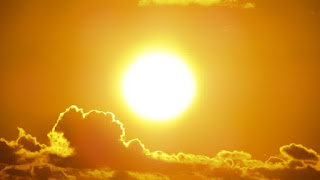
The Summer Solstice is a time of great power for this is when the days are at their longest and the Summer Sun is at its strongest. This is the sacred time of the great Sun Deities of the Northern Hemisphere such as the Celtic Lugh/Llew, the Irish ƀine, the Saami Beiwe, the Norse Baldr and Sol, the Baltic Saulė, the Romano-British Sulis, the Chinese Xihe, the Japanese Amaterasu and many more... In modern Paganism this is also the time of the Green Man or Jack in the Green who looks out at us still from churches and woodlands with his foliate face showing his connection to the fertility of nature at this time. These are the final glory days of the great Oak King who rules over the light half of the year, before the Holly King gains in power and takes over as the light wanes again. The Goddess moves from her maiden phase into her mother phase as she now carries the God's child to be born again in Winter. The Summer Solstice is also a very important day in the Faerie Cal...

The Sea Poppy (Glaucium flavum)

Image
  “The horned poppy with the yellow flower... groweth upon the sands and banks of the sea.” John Gerard, Elizabethan Herbalist. Like many others I am participating in the 30 Days Wild Challenge by the UK Wildlife Trusts throughout June to get my butt out into Nature as much as possible, though as  Witch I like to do that anyway, the challenge just helps give me added impetus and to participate in something far bigger. This morning, as I walked along the beach, I was greeted by these bright, happy sun-like flowers and naturally was wonderfully cheered by them. Their pale colour appeared to be particularly glowing and resplendent today perhaps aided by the shimmering white mist that was flowing in from the sea. Sea Poppies are the beaches', and Sea Witch's, version of the red field poppy which have also begun to flower and add colour to the land, but their energies are very different. Traditionally Sea Poppies are solar flowers linked with the power and poten...

The Rusalki

Image
This week is Green Week, an ancient Slavic Fertility Festival, also known as Rusalka Week ( Ń€ŃƒŃŠ°Š»ŃŒŠ½Š°Ń Š½ŠµŠ“ŠµŠ»Ń) in Russian because during this week the Russian Water Nymphs, the Rusalki, are said to be at their most dangerous and powerful. These days Green Week runs from midnight Pentecost Sunday to the midnight that heralds Trinity Sunday, so its dates move each year. Originally the Rusalki (singular Rusalka) were Fertility Faeries, Nymphs or Spirits who rose out from the lakes, rivers and streams in which they lived during Springtime to water and bless the land with fertility. As they walked on land for this one week of the year, especially through the growing rye or hemp fields, they watered it, for as they passed for their hair and clothes dripped with the water from their home body of water. They were one with Nature, working with the phases of the Moon, and able to control the weather. They were said to be in charge of the spring rains that watered the crops, and t...

Hello & Welcome to my YouTube Channel!

Image

Itchy Superstitions

There are many and varied superstitions when it comes to those annoying tickly itches that we all get from time to time. When it comes to superstitions the idea is that the itch is a message, it is trying to tell you something, and just what that may be depends on where the itch strikes. Of course, you don't have to believe in superstitions, but the idea of them is quite fascinating. Head - An itchy head is believed to be an omen that you will soon get a great idea or a promotion, as long as your hair doesn't have any visitors. Eyes and Eyebrows - On the right it indicates a meeting with an old friend, on the left with an old enemy or someone you'd really rather not encounter for whatever reason. Ears - If your right ear gets an itch it means that someone is talking well or highly of you, but if the itch is on the left ear it means conversely that someone is speaking ill of you - same as for cheeks. Cheeks - If your right cheek gets an itch it means that someone i...

Mother / Father Earth. In Honour of Earth Day...

Image
Mother Earth Pagan Prayer Beads by Cauldron Crafts Mother/Father Earth has had many names through the years, so to celebrate Earth Day I thought I'd write about a few...  Akka ('Old Woman') or MaderAkka ('Mother Woman') - Finnish and Saami Goddess of Fertility and Nature. She is the wife of Ukko, the Thunder and Sky God, and when they make love, thunder rolls. In Scandinavia thunder and its associated rain is often said in legends to make the earth fertile. Akka gives life to the body. Akka is associated with mountains such as the Ahkka massif in Sweden that still bears her name. Ceres ('To Feed') - Roman Mother Goddess of Agriculture, especially Grain, and Fertility. Ceres is said to have discovered spelt wheat, created the art of pastoral agriculture and created law and order. Our word cereal comes from her name, as do our words creativity , creation and increase . Ceres was honoured at a seven day festival in April called the Cerealia festiv...

The Wild Merman of Orford

Image
“Men fishing in the sea caught in their nets a wild man.” Ralph of Coggeshall The beautiful Suffolk seaside town of Orford boasts the stunning sands of the Ness, a fine Mediaeval castle and the ancient tale of a Wild Man or Merman.   Tales of Wild Men exist the world over, from the Himalayas are the tales of the Yeti, in Arctic Scandinavia is the Snƶmannen and in Scotland there are tales of the Fear Liath. Such Wild Men are usually associated with remote, mountainous areas where many mythical creatures, both big and small are still said to live.    Others are thought to be apparitions of the Wild Men of the Woods, akin to the ancient archetypes of the Green Man, the Lord of the Wildwood, Robin Goodfellow or Robin of the Green.   What makes the Orford Wild Man different is that he came out of the sea.   The coastal areas of East Anglia are rich in myth and folk magic.   Over the years many villages have been lost to the sea and many of their churc...

The Flowering Blackthorn

Image
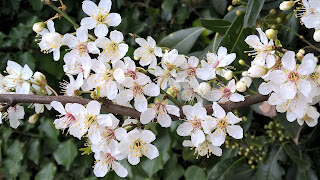
Like its lighter and beloved sister, the Hawthorn, who is said to rule over the light half of the year, Blackthorn has long been associated with Faeries, Witches and Magic. Blackthorn is often considered a darker, more sinister tree than its sister and it rules over the darker winter months for this is when it is in its element. At the start of winter the Blackthorn produces its wonderful deep blue/purple/black sloes and as winter ends the trees explode in ghostly white blossom. With its rich nectar and pollen, it is a lifesaver for many foraging insects, like bees, for whom there is little else at that time of year. With its shrubby and dense nature, along with the H awthorn, Blackthorn is a vital component of hedgerows which provide refuge and food for many birds, insects and small animals as well as the Fae. The contrast between the dark thorny stems and the beautiful white flowers is stark, rather like the contrast between the light of the moon and stars and the darkness...

The Bee in Folklore & Mythology

Image
(Originally written for the Bumblebee Conservation Trust ) The bee features as much in folklore from around the world as it does in our gardens in summer time. Yet, in this article, I can only scratch the surface of this vast body of information. Bees show up in human art forms almost as soon as mankind learned to create them; they are depicted in ancient rock art from around the world, for example from the Palaeolithic in Spain and from the Mesolithic in India and are mentioned in some of the earliest forms of writing in the world. Bees crop up everywhere from poetry to prose and even in our everyday sayings: we can be as 'busy as a bee', we 'make a bee-line' for things, we can get 'a bee in the bonnet' and the term 'bee's knees' now famously refers to something fabulous, although originally it referred to something small and insignificant. Bees are linked with magic, love, industriousness and creativity. The mere presence of bees on a ...